
Hamilton County Court Records After a Jail Arrest
An arrest in Hamilton County is only the first step in a longer chain. After booking at the jail, the case passes to the State Attorney for the Third Judicial Circuit, John F. Durrett, whose office files or declines the formal charges. When charges are filed, the Hamilton County Clerk of Circuit Court opens a case, and that case file is the court record. From that point on, the charges, hearings, and dispositions are tracked in the court system rather than on a jail roster.
It helps to keep the two sides apart. The booking and custody side is covered on the jail inmate records page, and booking photos sit on the jail mugshots page. The court record covers what the prosecutor actually charged and how each charge moved through the case. After an arrest, the court file is where charge level, court dates, bond, and the final outcome appear.
How to Find Hamilton County Court Records After an Arrest
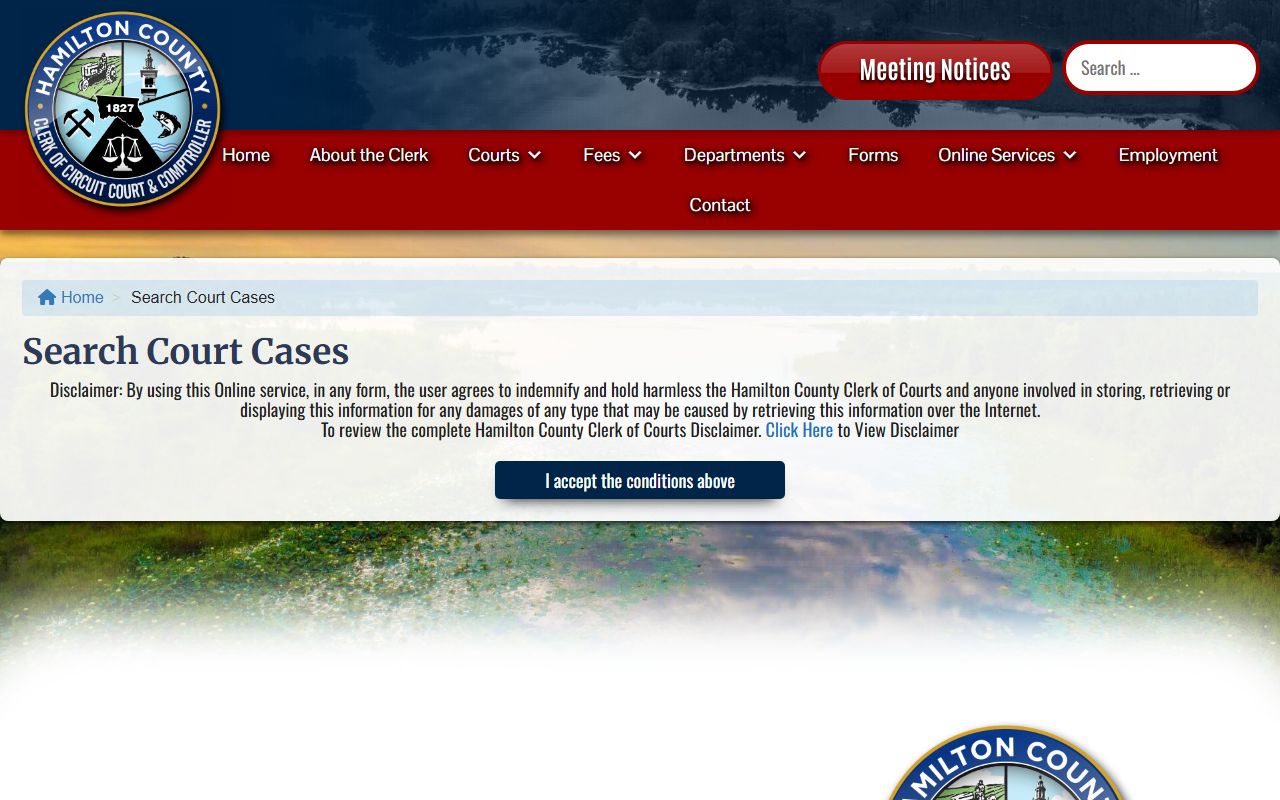
The Hamilton County Clerk's court-search page is the local starting point, and it links out to the Civitek Florida online court records system for the county. The clerk's page carries a disclaimer that the online data is a public service, so the search opens after you accept it.
The Hamilton County Clerk publishes its court-search landing page with the disclaimer and the link to the records portal.
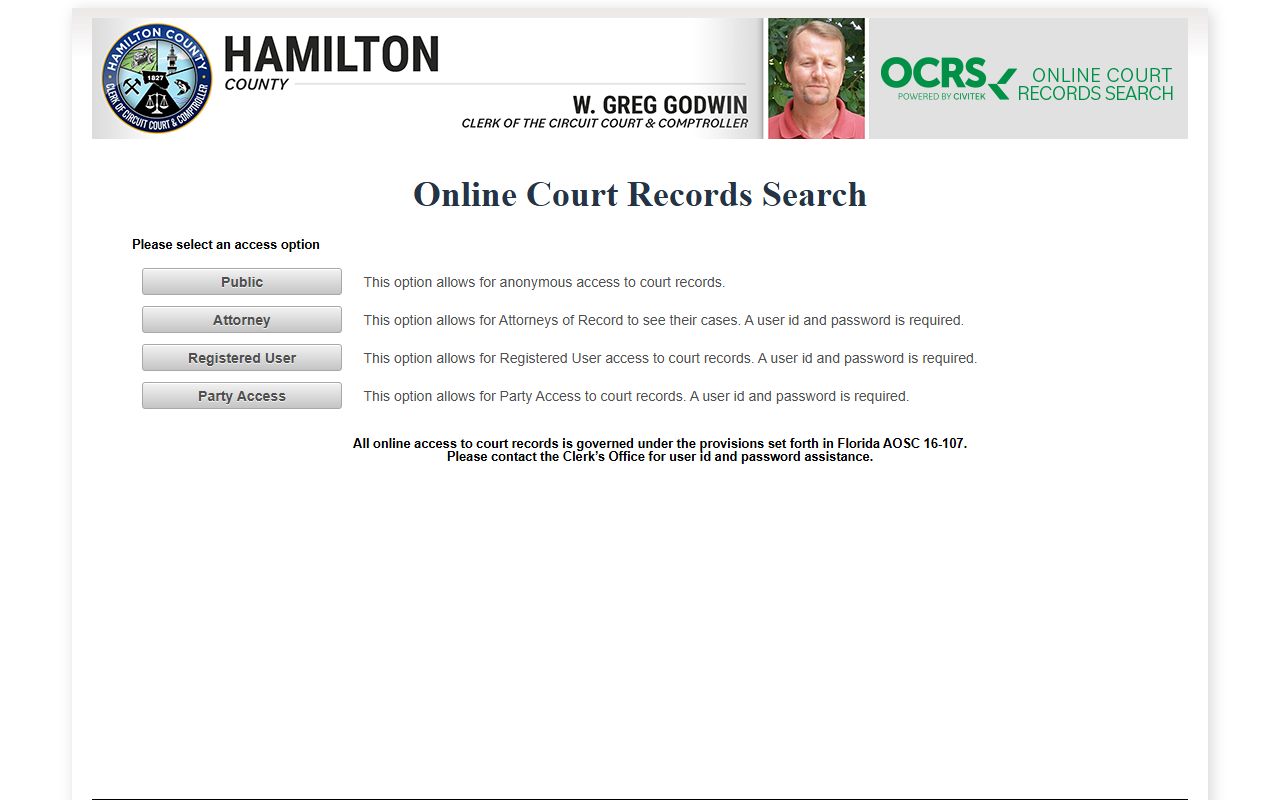
From there, the Civitek court records access screen offers Public, Attorney, Registered User, and Party Access options, and only the Public choice works without a login.
- Open the clerk court-search page and accept the public-access disclaimer.
- Choose Public access, then search by defendant name or by a case number from jail or bond paperwork.
- Open the case and read the charge list, the filing date, and the hearing schedule.
- Check each charge's court type, code, and current status, and narrow by court type if too many results return.
For a statewide criminal history rather than a single case, the FDLE Florida criminal history record check offers a public search for a $24 fee. That tool reaches beyond one county and is the right one when the question is about a person's overall record rather than a specific Hamilton case.
How Charges Get Filed After an Arrest: Complaint, Information, and Indictment
The court record begins when a charging document is filed. Booking happens at the jail first, but the formal accusation that opens a case takes one of three forms in Florida. A complaint is common for lower-level matters, a prosecutor's information drives many felonies, and a grand jury indictment is used for the most serious felonies. The clerk's criminal pages explain that the circuit court handles felonies while the county court handles misdemeanors and criminal traffic.
| Complaint | Information | Indictment | |
|---|---|---|---|
| Filed By | Officer or prosecutor | State Attorney | Grand Jury |
| Common For | Misdemeanors | Many felonies | Serious felonies |
| Starts | The case | The case | The case |
The clerk's felony page describes arraignment as the hearing where the defendant is advised of the filed charges and enters a plea, with status conferences, pretrial settings, and trial following a not-guilty plea.
Charge Status and What It Means After an Arrest
Charges are not fixed once a case opens. A prosecutor can amend a charge, reduce it to a lesser offense, add a count, or drop it. That is why the arrest charge on a booking record can differ from the charge the court record finally shows. The terms below appear often in a Hamilton County case file.
| Status | What It Means |
|---|---|
| Pending | The charge is filed but not yet resolved. |
| Amended / Reduced | The prosecutor changed the charge or lowered it to a lesser offense. |
| Dismissed | The court or prosecutor ended the charge. |
| Nolle Prosequi | The prosecutor decided not to continue the prosecution. |
The court-search portal can be filtered by court type, which matters because a DUI, a driving-while-suspended charge, or a local ordinance case may not appear if only the felony box is checked. The case-search field table further down shows the search inputs the portal accepts.
Hamilton County Court Case-Search Fields
The public Civitek search form was inspected during research, so its fields are documented below. A live case result could not be captured because the search submission was blocked by a portal challenge, so no result fields are invented here.
| Field Label | Type | Required | Notes |
|---|---|---|---|
| Last Name | Text | Yes for a person search | Maximum length 30. |
| First Name / MI | Text | No | Maximum length 40. |
| Date Case Filed (From / To) | Date | No | MM/DD/YYYY range. |
| Date of Birth | Date | No | MM/DD/YYYY. |
| Court Type | Checkbox group | No | Felony (CF), Misdemeanor (MM), Criminal Traffic (CT), and others. |
Note: filing date can run later than the arrest date, so a wide date range helps when a case is too new to appear under a tight filter.
Bond and Release After an Arrest
Hamilton County sits in the Third Judicial Circuit, and bond before first appearance follows Administrative Order 2026-001, the circuit's uniform bond schedule signed in January 2026. That schedule is for use before the next first appearance only, and it does not bind the judge at the hearing. The clerk's felony page adds that a person who cannot bond out within 24 hours appears before a county judge, and a weekend arrest leads to a first appearance held at the jail.
The Third Judicial Circuit bond schedule order sets the pre-first-appearance amounts.
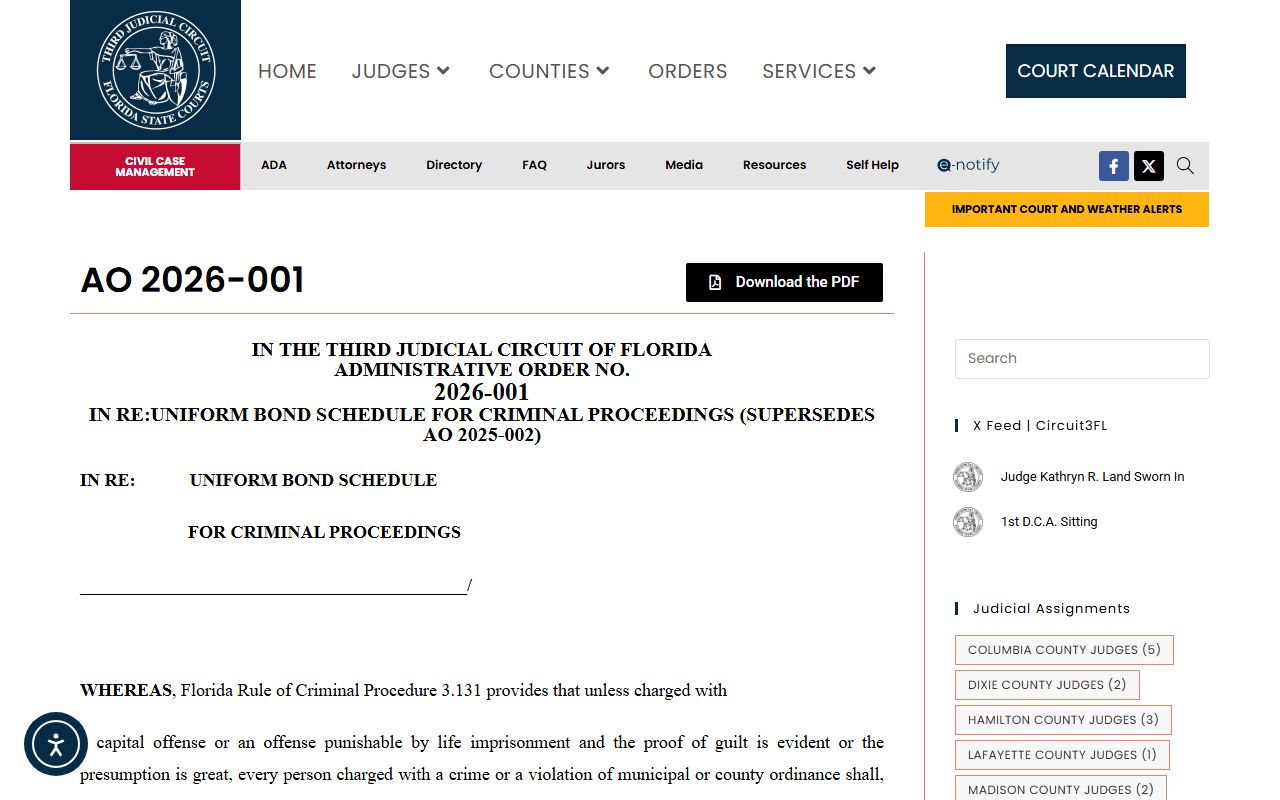
Under the order, a third-degree felony with force is set at $10,000 and without force at $5,000, while certain dangerous and serious offenses carry no bond and require first appearance.
| Bond Type | How It Works |
|---|---|
| Cash Bond | The full amount is posted directly in money. |
| Surety Bond | A licensed bail bond agent posts the bond for a fee. |
| PR / Own Recognizance | Release on a written promise to appear, set by the judge. |
| No-Bond Hold | No release before judicial review, used for certain serious offenses and warrant holds. |
Warrants That Lead to an Arrest
An outstanding warrant is a common path into the jail. No Hamilton County sheriff active-warrant list was found on the official pages, so the statewide channel is the FDLE Wanted Persons search, which lists a reporting agency and warrant details. FDLE warns that a result is not confirmation of an active warrant and is not grounds to act, so anything found there should be confirmed with the court or the agency.
If a warrant is tied to an existing Hamilton County case, it usually appears in the clerk's court record by name or case number. The clerk's felony page notes that a failure to appear can produce a warrant and a bond forfeiture, and a person arrested on a failure-to-appear warrant may be held without bond until a judge reviews it.
Charges vs. Convictions in the Court Record
Being arrested and charged is not the same as being convicted. A charge is an accusation that opens the case, while a conviction is the outcome after a plea, a trial, or an adjudication. Both are public, but they sit at very different stages of the same court record.
| Charge | Conviction | |
|---|---|---|
| Stage | Accusation | Verdict or plea |
| Burden of Proof | Probable cause | Beyond a reasonable doubt |
| Public Record | Yes | Yes |
Sealed vs. Expunged Arrest Records
A dismissal, a nolle prosequi, or an acquittal does not erase an arrest record on its own. Clearing it is a separate process under Florida law, and the first step is an FDLE certificate of eligibility before petitioning the court. Sealing makes an eligible record confidential, while expunction removes public access and treats the record as destroyed.
| Sealed | Expunged | |
|---|---|---|
| Visibility | Hidden from public view | Treated as if it never existed |
| Law Enforcement | Limited access | Very limited access |
| Eligibility | FDLE certificate first, under Florida Statutes 943.059 | FDLE certificate first, under Florida Statutes 943.0585 |
The certificate of eligibility carries a fee and is valid for a set period, and neither sealing nor expunction happens automatically just because a charge was dropped.
Background Check Considerations
There is a real difference between a casual public-records lookup and a regulated background check. A regulated screening for employment, housing, or credit must follow the federal Fair Credit Reporting Act and use a consumer reporting agency. A court-record search for personal information is not the same thing and carries none of those protections or permissions.
Important: This site is a public-reference resource, not an FCRA consumer reporting agency, so its content may not be used for hiring, housing, credit, or insurance decisions.
Restricted Court Records After an Arrest in Hamilton County
Some records are limited even though most court files are public. Juvenile delinquency cases are more restricted than adult cases, sealed or expunged charges are removed from public view, and victim information can be protected, including under Marsy's Law. Active investigative details may be withheld while basic arrest facts stay open. For prosecutor records rather than clerk docket entries, the State Attorney's public-records channel handles requests, which may be made by phone, in person, mail, or an online form, and may be anonymous, though fees can apply before copies are processed.